
The Freewoman of Ullswater
Dora Marsden – The Sovereign Mind of Seldom Seen
Dora Marsden reasoned that individual agency cannot be given by external entities; it must be taken by the self. Rejecting state authority, political parties, and figures with made-up titles, she insisted every human mind is the architect of its own experience. Her trajectory from working-class poverty to militant suffragette, modernist editor, and fellside metaphysician remains an extraordinary study in individual sovereignty.
Stage 1: The Crucible of Poverty and Motherly Devotion (1882–1908)
Dora Marsden’s story begins in severe hardship. Born in 1882 in Marsden near Huddersfield, in the West Riding of Yorkshire, her family was plunged into poverty when her father, a woollen waste dealer, abandoned his wife and five children after his business failed. Emigrating to Philadelphia with her eldest brother around 1890, he provided no financial support to the family in Yorkshire and died in America in 1913.
Her mother, Hannah Marsden, refused to let poverty crush her household. Taking in sewing, Hannah worked tirelessly to raise her remaining children, instilling in young Dora a sharp intellect and fierce self-reliance. Hannah’s resolve ensured Dora received an education—a rare feat for a working-class girl. She became a pupil-teacher at 13 and won a scholarship to Owens College in Manchester. She graduated in 1903, and went on to become a headmistress.
Stage 2: The Suffragette and the Break with Authority (1909–1911)
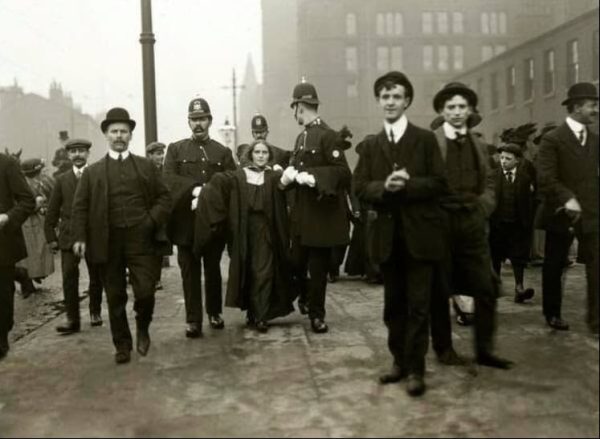
By 1908, Marsden threw herself into the militant campaign for women’s suffrage with the Women’s Social and Political Union (WSPU).
She quickly became a star organiser, scaling roofs to protest and enduring multiple arrests, imprisonment, and hunger strikes. In Strangeways Prison, she famously refused prison uniform, stripping naked in resistance to state authority.
Yet her disillusionment was swift. Marsden realised the WSPU was deeply autocratic, demanding blind obedience. To her, begging the state for the vote was merely asking a system for permission to exist. She resigned in 1911, concluding that freedom was not a legal right to be awarded, but something to be claimed by the self-governing individual.
When World War I broke out, Marsden strongly condemned the “White Feather” campaign—where former suffragette colleagues like Christabel Pankhurst handed out white feathers to shame un-enlisted men into joining the war effort. To Marsden, coercing young men into industrial slaughter through social manipulation was the ultimate betrayal of individual sovereignty. She saw it as collective moral tyranny: an arrogant, self-appointed authority attempting to override an individual’s right to govern their own body and life.
Stage 3: The Freewoman, The Egoist, and James Joyce (1911–1919)
In late 1911, alongside co-editor Mary Gawthorpe, Marsden launched The Freewoman, which evolved into The Egoist (1914–1919) with crucial financial and editorial support from Harriet Shaw Weaver. Under their stewardship, the review dismantled social authority and became a vanguard for literary modernism.
The Egoist began serialising James Joyce’s A Portrait of the Artist as a Young Man in 1914, giving the emerging modernist writer a crucial platform at a time when his work was proving difficult to publish. Weaver’s financial and editorial support would later become an important part of Joyce’s struggle to bring Ulysses into print.
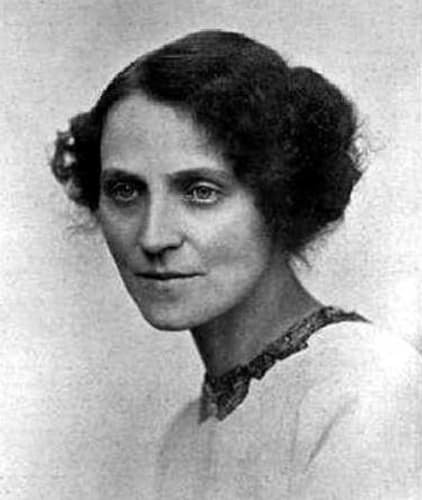
Stage 4: Seldom Seen and the Search for Ultimate Reality (1920–1935)
By 1920, Marsden concluded that political commentary was merely preliminary; true freedom required understanding the mechanics of reality itself.
She withdrew to Seldom Seen, a secluded row of cottages high on the fellside of Glencoyne overlooking Ullswater, where she lived with her lifelong companion, Grace Jardine, and her mother, Hannah.
High above the valley and the industrial noise of the nearby Greenside lead mine, Marsden devoted herself to an all-encompassing metaphysical project. In works like The Definition of the Godhead (1928), she attempted a unified theory of consciousness, exploring the relationship between space, time, language, and a deity, with the individual Ego at the centre of her philosophical system.
Epilogue: The Hospital Years and the Unbowed Mind (1935–1960)
The fellside sanctuary was shattered in 1935 by the death of her mother, Hannah. Later that year, as Marsden’s mental health deteriorated severely, she was admitted to Crichton Royal Hospital in Dumfries.
Though institutionalised for the remainder of her life, her commitment never wavered; she continued writing and refining her philosophical manuscripts until her death in 1960.
Dora Marsden began as a child of poverty raised by a steadfast mother, fought on the frontlines of women’s liberation, helped forge literary modernism, and ended as a fellside philosopher seeking the laws of existence above Ullswater.
She was The Freewoman of Ullswater—a mind that refused every master, bowed to no doctrine, and lived according to the conviction that true freedom began with governing oneself.