
The History of Ullswater: Rocks, Railways & Rewilding
Deep Time: The Volcanic Foundations
The story of Ullswater begins not with people, but with fire. Around 450 million years ago, the foundations of the Lake District were forged by intense tectonic activity. This wasn’t a simple bubbling of magma, but a series of cataclysmic explosions of the Borrowdale Volcanic Group. Massive volumes of ash and lava were ejected, eventually cooling into exceptionally resilient rocks known as tuffs (volcanic ash) and andesites (fine-grained volcanic rock). These silica-rich foundations formed a hardened, mountainous plateau—a stubborn mineral canvas that would resist erosion for hundreds of millions of years, ultimately becoming the jagged, craggy fells of the Helvellyn range that frame the lake today.
The Great Sculpting: 450,000 Years of Ice
While the planet had been cooling for over two million years, the primary shaping of the modern valley began in earnest around 450,000 years ago during the Anglian Glaciation. This was the first of several massive ice sheets to grind across the North, acting like a giant, frozen rasp. These glaciers repeatedly advanced and retreated, gouging out deep corries (bowl-shaped hollows) and widening narrow river joints into the distinctive U-shaped valley we see today.
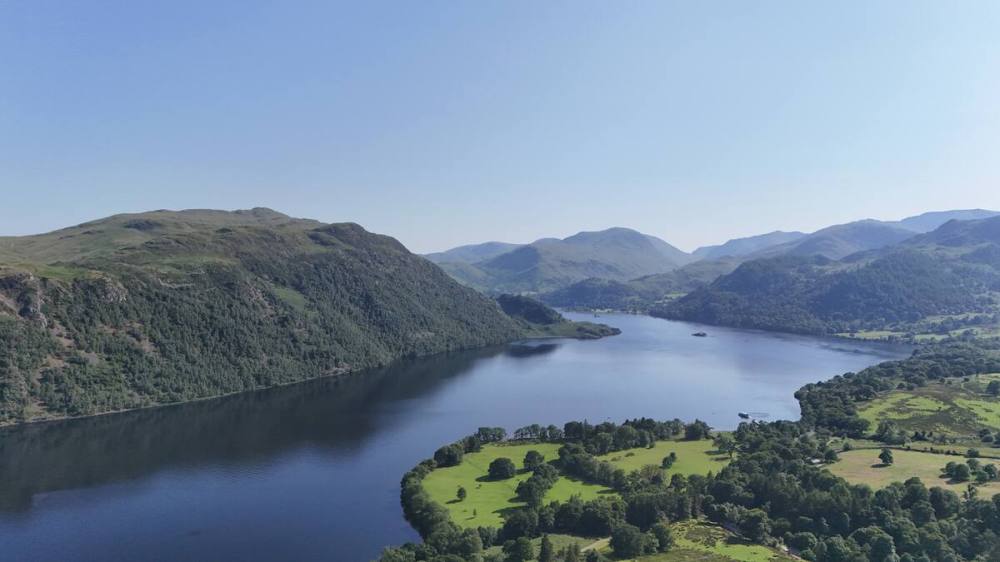
After the main ice sheets retreated, the climate began to warm, only to be interrupted by a sudden, brutal return to glacial conditions known as the Younger Dryas (roughly 12,900 to 11,700 years ago). During this period ice was restricted to upland areas. In the Lake District, glaciers were largely confined to the high fells, though the southernmost extent of these valley glaciers reached as far as the Brecon Beacons. In the Ullswater valley, these glaciers gave the landscape its final, sharp polish and deposited the rocky debris—moraines (accumulations of earth and stones)—we see along the shoreline. When the ice finally vanished for good, for now, around 11,700 years ago, the deep, scoured hollow filled with melt water to create Ullswater. Today, as we paddle along, we are floating over the literal scars of this 450,000-year sculpting.
From White to Green
As the ice withdrew, soils and rivers began to form. Small streams converged, depositing layers of gravel and silt, slowly creating fertile valley floors. The earliest plants, hardy mosses and pioneer species, colonised the exposed rock, setting in motion the ecological succession that would eventually support trees, animals, and people that we all interact with today.
Trees, Animals, and Early Peoples
With the retreat of glaciers, as with other similar latitudes around the planet, southern Ullswater slowly became hospitable to life. Birch, hazel, and rowan were among the first trees to take root, gradually giving way to oak, ash, and alder in richer soils. These forests created habitats for deer, wild boar, and small mammals. Rivers teemed with fish, and the valley provided a reliable, ready, source of food and materials for the people who would eventually arrive.
People arrive
The earliest human inhabitants were likely small groups of hunter-gatherers, following in the wake of the flora and fauna spreading north. This, proven, sustainable, way of life lasted for at least 4000 years in this area. Eventually, gradually, people we now refer to as Brythonic Celts came to call the lake and the surrounding area, home. The Celts were here well before the Romans, they thrived while the Romans were around, and they were here for centuries after the Roman withdrawal. Southern Ullswater lay within a region known to the Celts as part of Hen Ogledd (“Old North”), lasting roughly 250 years from the 5th to the 7th century. Locally, the area was part of Rheged, a kingdom whose boundaries are debated but likely covered the Lake District and surrounding uplands; Rheged persisted for roughly 200 years, overlapping with Hen Ogledd. In later centuries, southern Ullswater fell under the influence of Strathclyde, which endured for around another 200–300 years, well into the 10th century, before Norse and limited Anglo Saxon pressures reshaped control.
Celtic Land Management and Way of Life
The Celts way of life was geared towards stewardship of the land rather than extraction. Managing pastures, rivers, and woods sustainably. Life was spiritual: the Celts lived in partnership with the land and their spirits, following seasonal cycles and respecting sacred places, waters, and trees. Their society was centred on kinship networks and seasonal festivals. Oral traditions structured social life. Their day to day existence wasn’t perfect by any means, but the people could enjoy what the valley naturally provided.
Cattle were central to Celtic life: they provided milk, meat, and hides, and grazing patterns maintained soil fertility. Sheep were far less common, as their grazing could degrade fragile upland soils. Hunting, fishing, and gathering supplemented subsistence. This land management, intertwined with spiritual belief, protected much of the valley’s ecology for centuries.
Nature’s Gifts
Among the community were Wise Women, highly skilled in herbal medicine, whose knowledge of plants and healing remedies ensured health and preserved traditional wisdom. I’ve been lucky enough to have a few herbalists out on the trips and their stories always interest me. For instance, how Meadowsweet, being gentler, was preferred to Willow bark as a pain reliever, and what modern day common pain killers are now made from was very much an eye opener.
Another fascinating aspect of the Celtic way of life is just how much they valued the local trees. Deforestation certainly occurred, but nowhere near the wide scale felling of later centuries. They had many laws protecting certain trees for a variety of reasons. Coppicing and pollarding were also very much part of their management techniques.
If you come along on a kayak tour and you know anything about herbs, portals, or pretty much anything to do with these remarkable people, I’m all ears. They certainly didn’t create a paradise, but they did very much work with nature rather than try to dominate it. It really is difficult not to over romanticise these people. Past guests have been very informative, educating me that certain birds, trees, wells and seasonal festivities that were very important in Celtic life, retain their significance to this day.
Romans, Anglo Saxons and Hiberno Norse
The Romans left traces in the Lake District, including roads and forts such as the High Street route, but these had no lasting impact on the southern parts of Ullswater. The valley itself remained largely untouched, and Celtic families continued their sustainable ways of life. The Romans might, however have added to one change around the area that is now thought of as ‘ normal ‘. The colour of the sheep. The natural ancestors of sheep, being prey animals, weren’t white, as that would make them very easy targets for predators. White was bred into them by humans looking for a better base for their coloured dyes. The Romans were in favour of this and brought with them breeds that cross bred with the local stock in many places to make the fleeces even whiter. When the Norse brought over the ancestors of the Herdwicks, as their priority was the sheep surviving on the fells, rather than selling the wool abroad, as was the case with the Normans and the Cistercians who came later, they kept the hardier breed.
Migrations continue
Settlement patterns reflected practical and spiritual choices. The small amount of Saxons were more Northumbrian Angles, who lived around the area and favoured lowland places, with fertile soils and accessible rivers ideal for mixed farming. The Hiberno Norse, Scandinavians who’d already settled in Ireland, and absorbed Gaelic culture, before sailing over from Dublin, favoured uplands. They used the remote fells for sheep grazing where steep, less fertile land could still be productive for wool. The Celts, by contrast, settled in valleys and along glens, naming places descriptively, often referencing colours, shapes, or natural features, rather than people. This is why many valley names survive as references to physical features. Some of these later mixed with Norman names that emphasised ownership.
By the 9th and 10th centuries, waves of Hiberno Norse settlers arrived from Dublin, drawn by trade networks and the promise of upland pasture. They occupied, and named, remote fells for sheep grazing and blended with the existing Celtic and Anglo Saxon populations. By the time their ‘ energetic ‘ cousins, the Normans, arrived, southern Ullswater was a patchwork of Celtic valley settlements, Anglian lowland farms, and Norse upland sheep pastures.
The Norman Yoke, Sheep, and The Enclosures
Before the 11th century, the fells and dales around Ullswater were managed by a resilient mosaic of people—Brythonic Celts, Anglians, and Norse settlers. These communities were skilled stewards of the land, sustaining themselves through a balanced cycle of hunting, fishing, and seasonal grazing. Life was governed by ecological knowledge handed down through generations, ensuring the valleys provided a sustainable way of life.
The arrival of the Normans had a massive effect on the area. They introduced a system of subjugation often termed the Norman Yoke. After they said that they now owned all the land, and used their military to enforce that claim, control was stripped away from those without political influence or the means to buy favour. Villages were uprooted and pastures seized, but perhaps the most profound change was the criminalisation of survival. Under Norman Forest Law, “Forest” wasn’t as we understand it in a modern day sense. The Normans made it a powerful legal designation. It could encompass moors, fields, and entire rivers, placing them under a jurisdiction where everyday activities like gathering wood or carrying a bow could be punishable by blinding or amputation. Of course there was fierce resistance to this, and many from this area and others, joined together and fought back. Often using upland woods as both refuges and ambush opportunities. The Normans called some of these people Silvatici, ( people of the woods ) and would suffer many losses against them when the terrain favoured human foot rather than horses hoof.
The Holy Deal for Wool
The shift toward a wool dominated economy was driven by a unique intersection of commercial ambition and spiritual anxiety. Following their extremely violent campaigns, many Normans were unsettled by what their religion told them. It suggested that their actions required significant penance to avoid eternal damnation. Believing salvation could be secured through financial means, they struck deals with the Church, granting vast tracts of northern land to the Cistercians.
The Cistercians were the workaholics of the monastic world. Around this area, and others, they replaced sustainable mixed farming with very large sheep operations. These were the medieval sheep factories, designed not for local sustenance, but for a sophisticated global enterprise.
-
International Markets: The wool was destined for the high end textile hubs of Flanders and Florence, where the appetite for English fleece was insatiable.
-
The “Staple”: The monks became expert breeders, meticulously selecting for the staple, the specific length and quality of the wool fibre, to meet the exacting technical standards of European looms. As mentioned earlier, they favoured white as a base, as their customers throughout Europe favoured it as a base for their dyes. The Herdwicks of the area were more used for meat or payment of taxes, than their fleece.
The Hostile Takeover and Enclosure Acts
This white gold came at a steep human cost, sparking frequent conflicts over the remaining communal land. In places tensions reached a breaking point as monastic boundaries pushed into traditional grazing grounds. The Normans viewed this as a calculated exchange: they outsourced the management of the fells to the monks, securing a steady stream of prayers and profit while the local populace was displaced to make room for the flocks.
The bridge between these monastic empires and the modern landscape was the Dissolution of the Monasteries. This was less about religious fervour, or taking precious metals from their places of worship, and more about a state facilitated takeover of the wool infrastructure. The monastic estates were sold to a new class of more secular people, who viewed the land strictly as a commercial asset.
From the 17th century through to the early 19th century, a series of Enclosure Acts formalised this displacement. Land that had been communally held for centuries was consolidated under wealthy owners. Mirroring the Highland Clearances in Scotland, the families around Ullswater were systematically removed to prioritise sheep. The resulting landscape of dry stone walls and abandoned settlements is not merely a scenic vista; it is a physical record of a centuries long journey from local harmony to global industry. It was often the case that the people who actually carried the stone to build the walls, knew they could no longer live on that land that for generations had been their home.
Fishing on Ullswater
By the 18th and 19th centuries, Ullswater supported fisheries, with many small operations harvesting Arctic Char and Brown Trout. Eventually, over fishing and pollution from Greenside mine, especially following the 1927 Keppel Cove Disaster, collapsed these stocks. In the early 1900s, Perch was introduced as a sport fish. They did well as a species in Ullswater. They survived the lead poisoning from the Keppel Cove event due to their egg laying being different to the Char, and because Pike, which would be their main predator, are few and far between in the lake due to the geography of the sides of the lake. It’s steep in many places, Pike being an ambush fish, prefers shallow pools.
The Irish and the Mines
Irish workers, fleeing the Potato Famine and its after effects, of the mid 1800’s, arrived to work in the mines at Greenside Mining Company alongside people from Durham, Cornwall, Wales and other areas. Many of the Irish faced exclusion from local settlements and were forced to live in the remote hamlet of Seldom Seen, perched above Glencoyne, the valley we very often see while paddling along.
A fair day’s wage for a fair day’s work ?
Life for these men was incredibly difficult, winters harsh, walking two hours in clogs just to arrive at the entrance to the mines, even before descending into the everyday dangers. You might think the men earned a fair days wage for a fair days work. You would be very wrong. The incredibly exploitative ‘ Bargain System ‘ meant that, unbelievably, the miners could end up, after two months of work, owing the owners money due to being forced to buy the equipment they needed to do their job from the company store. A more accurate description might be debt bondage. It was only when the men came back from WW1 and went on strike in 1924 that the Bargain System was replaced by a minimum wage. The press of the day said the strike was caused by Bolsheviks and that paying a minimum wage would be the death knell for society. Other ‘delights’ that happened at the mines were children as young as 12 working 14 hour days before parliament was shamed into banning the practise. The harshness faced reflects a centuries long pattern of displacement, forced labour, and marginalisation in the area.
Railways, Tourism, and Modern Legacy
By the mid-19th century, Ullswater’s valleys began to open in new ways. The coming of the railways connected Penrith, Keswick, and surrounding towns to the wider industrial network. Visitors could now reach southern Ullswater easily, and the landscape that had been shaped by glaciers, forests, Celts, Saxons, Norse settlers, and Norman enclosures began to attract a different kind of attention: leisure and tourism.
Tourism takes off
Hotels and inns grew in Glenridding and Pooley Bridge, and paddle steamers carried sightseers across the lake. The railway allowed local farmers to market wool and produce more widely, offering some economic relief, though traditional pastoral and fishing livelihoods had already been transformed. Some of the displaced families, and descendants of Irish miners, found new opportunities, while others remained marginalised, a reminder of centuries of social upheaval.
Fishing continued, now for sport as much as commerce, and woodland restoration and land management slowly revived parts of the valley’s ecological richness. Yet the legacy of past events is still visible: upland sheep pastures, dry stone walls, abandoned settlements, and hamlets like Seldom Seen mark a landscape shaped as much by human cruelty and profit as by glacial forces.
Balance Regained ?
In recent years, a growing number of farmers around Ullswater are re-evaluating traditional practices, mirroring and maybe taking inspiration from the ancient Celtic ways. They are incorporating more cattle, especially Shorthorns and Belties., both of which mimic the Aurochs, which would have naturally been around Ullswater in the past. The new stewards of the land are reducing sheep numbers, and employing “mob grazing” techniques to mimic natural grazing patterns. This approach avoids intensive overgrazing, which was leading to an acidification death spiral of the land. Fewer sheep allows soils to recover, improves biodiversity, and restores some of the ecological balance that the Celts maintained for centuries.
Rewilding
Beyond farming, broader conservation and rewilding efforts are very much reshaping the region. Projects such as the South of Scotland Golden Eagle project are reintroducing and protecting these beautiful raptors. They’ve already been spotted checking out both Ullswater and, especially, Haweswater. Danny & Maddy at the Ullswater Catchment Management initiative work with many people to maintain healthy rivers, wetlands, and fish populations. Nearby, rewilding around Haweswater encourages woodland regeneration, natural grazing patterns, and wildlife corridors, reflecting the same ecological wisdom that guided the Celts. Together, these efforts show a growing recognition that human activity and natural ecosystems can coexist sustainably, if guided by knowledge, patience, and respect for the land.
Inevitably there are various motivations for rewilding. As well as those who see it as repairing some of the mistakes of the past few centuries, there might very well be Greenwashing and its twin, Greenhushing at play in some areas. Is the three tiered ELM system fair to all, or is it heavily biased towards large land owners rather than the tenant farmers ? Are local tenant farmers and international corporations the modern day equivalent of the Celts & Normans ? Please feel free to do your own research and come and chat about it while paddling.
From the water, all of this becomes visible — the glacial curves, the sheep-lined slopes, the hidden mining scars, and the slow return of woodland. Paddling Ullswater isn’t just a tour. It’s travelling through 500 million years of history.
Book your tour here : Kayak Tours on Ullswater