Ullswater Place Names: Their Origins and Stories
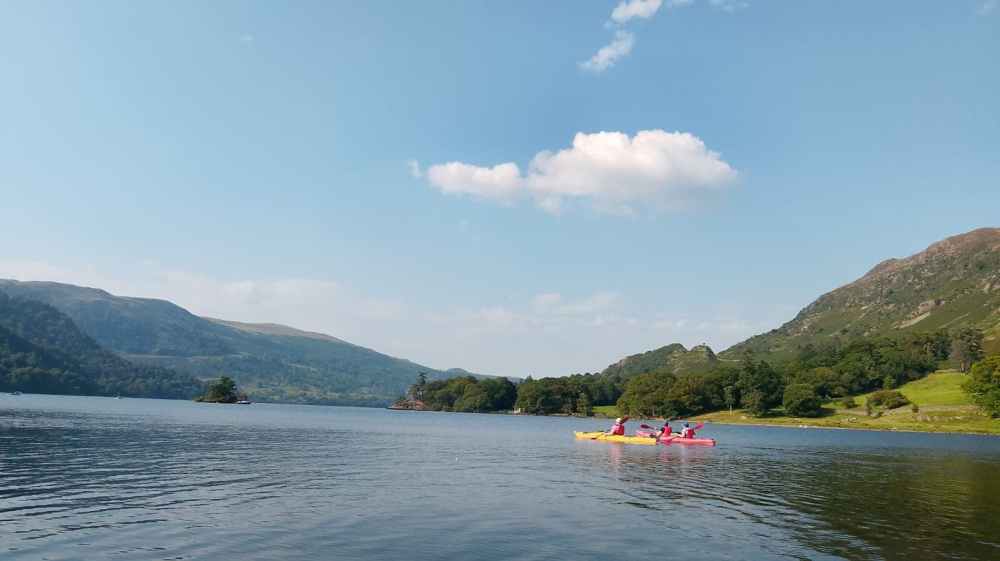
Ullswater is just a nice place to spend some time. Paddling along, enjoying the views, contemplating the sheer history of all the different peoples who called it home and left the place names that we use today. Water, rock, light, and weather dominate, but almost every feature carries a name whose origin has been shaped by centuries of settlement.
The lake itself is usually understood as Old Norse — likely “Ulf’s water,” from a personal name attached to a body of water.
The word Cumbria shares the same root as Cymru (the Welsh name for Wales). Both derive from the Brittonic word “Combrogi,” which means “fellow-countrymen” or “compatriots.”
The Oldest Layer: Brittonic North
Some high and dominant features preserve Cumbric roots.
-
Helvellyn – From Brittonic hal (moor) and melyn (yellow). It likely translates to “Yellow Moor,” describing the high, pale upland grasses.
-
Blencathra –From Cumbric blaen (summit) and cadair (chair). This “Seat of the Summit” perfectly describes the mountain’s iconic saddle-like shape.
-
Penrith –Derived from Cumbric Pen (head/end) and Rhyd (ford). It signifies the “head of the ford” over the River Eamont.
The Celtic mindset was descriptive, naming land for appearance or function — practical for travellers, herders, and villagers. Rivers, such as the Eamont, often retain these early names because hydronyms are conservative.
The Story of Why the Uplands Sound Norse
By the early 900s, groups of Norse settlers began arriving in Cumbria from Ireland, the Isle of Man, and the Irish Sea region. Many were Hiberno‑Norse, Norse who had lived for generations in Ireland and often mixed with the Gaelic population. Their arrival in this region is closely linked to the expulsion of the Norse from Dublin in 902 AD, when the long‑established Norse kingdom of Dublin was overthrown by a coalition of Irish kings.
The Norse in Dublin had been both rulers and traders, but over time they became increasingly entwined in Irish politics, warfare, and alliances. When the coalition of Irish kings forced them out, they lost their political base and were left with few options. Many crossed the Irish Sea seeking new lands and grazing ground, turning to places like Cumbria, Lancashire, and the Wirral where they could establish communities and livestock economies.
Norse‑Gaels — people of mixed Norse and Gaelic heritage — also arrived, fluent in both languages and blending cultural practices. They left their mark in upland place‑names:
-
Fell (fjall) – mountain
-
Dale (dalr) – valley
-
Beck (bekkr) – stream
-
How (haugr) – mound or hill
-
Thwaite (þveit) – clearing
-
Hause – mountain pass
While the Celts named descriptively, the Norse often emphasized ownership or association, reflecting social organization and grazing management.
Settlement Patterns and Language
The Norse‑speaking settlers did not occupy the best lowland arable estates, which were already controlled by Anglo‑Saxons or earlier Brittonic communities. Instead, they settled uplands, valleys, and marginal pastures — the fells, ridges, and side valleys — areas suitable for grazing sheep and cattle in a transhumant system. As a result, Norse or Norse‑Gaelic terminology dominates the upland landscape.
Streams, Valleys, and Waterfalls
-
Glencoyne – “Glen” traces to a Gaelic term for valley; “Coyne” likely preserves an older Celtic river name, making this a hybrid.
-
Patterdale – Norse dalr (valley) combined with what is often interpreted as a Christian personal name (Patrick).
-
Aira Force – “Force” from Old Norse foss, the word for waterfall.
-
Angle Tarn – “Tarn” from Old Norse tjörn, a mountain pool or small lake; “Angle” likely describes its shape.
-
Glenridding Dodd – “Dodd” is used locally for a rounded hill; from Norse doddr, meaning a smooth‑contoured summit.
-
Catsycam – likely Norse in origin; local oral forms suggest “cat’s ridge,” though exact etymology is uncertain.
Roman Roads and Movement
High Street preserves an English term for a Roman route along the ridge. Here, infrastructure, reuse, and naming combine: Roman construction, English descriptor, later pastoral use.
Nearby Settlements
Settlements around Ullswater reflect both the people who lived there and how the land was used:
-
Patterdale – Norse dalr + possibly Christian personal name (Patrick), “Patrick’s valley.”
-
Hartsop – Norse hjǫrtr (deer) + hop (enclosed valley), “deer enclosure.”
-
Pooley Bridge – English, “bridge over the pool,” reflecting practical estate mapping.
-
Glenridding – Gaelic glen + ridding (clearing), “cleared valley.”
-
Martindale – Old English/Norse hybrid, “Martin’s valley.”
-
Thornthwaite – Norse þveit (clearing) + “thorn,” describing vegetation.
-
Askham – Old English, “ash tree homestead.”
-
Howtown – Norse haugr (hill/mound) + English “town.”
-
Sandwick – Old Norse sand + vik (bay/inlet), “sandy bay.”
-
Dockray – Possibly from Old Norse dokk (hollow) and vrá (nook), meaning “the nook in the hollow.”
Reading the Landscape
From Pooley Bridge up to Place Fell, through Glencoyne, along Goldrill Beck, past Aira Force and Angle Tarn, up to Glenridding Dodd, Boredale Hause, and Catsycam, you cross centuries of settlement history.
-
Uplands speak Norse — often Hiberno‑Norse or Norse‑Gaelic.
-
Lowlands and valley floors speak English, often descriptive.
-
Highest summits and rivers whisper Cumbric, the oldest layer.
Each name — fell, dale, beck, tarn, dodd, hause, or town — records who used the land and how. Celts described what they saw; the Norse claimed what they could use.
Of the many aspects that I enjoy about paddling along in a kayak, learning about the people who have passed through the area in the preceding centuries is one of my favourites. The origins and stories of places around Ullswater and many other locations is always a good place to start researching to discover who was there and what did they do.